City of Rogues and Schnorrers by Jarrod Tanny
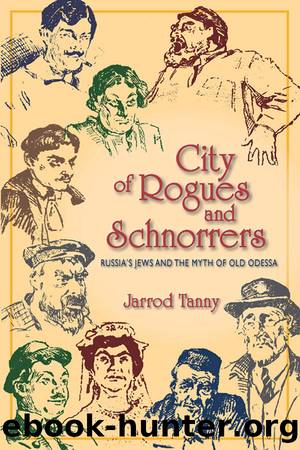
Author:Jarrod Tanny
Language: eng
Format: epub
ISBN: 9780253001382
Publisher: Indiana University Press
The anecdote was a dynamic form of entertainment whose appeal was largely rooted in its flippant approach to Soviet life and the many taboo subjects the regime sought to eliminate from public discourse. And with its brothels, Jewish gangsters, and immoral merriment, old Odessa was often the focal point of this forbidden humor.
The anecdote and the magnitizdat exemplify the diffuse nature of the Odessa myth in the post-Stalin era. And just as Sheinin, Paustovskii, and Utesov revived old Odessa in print at the national level, technology and succinct anonymous humor ensured its sustained commemoration thousands of miles from its point of origin on the Black Sea. But mythmaking did in fact return to Odessa in the 1960s, once a space had been carved out in the public sphere, where Odessans could boast and laugh about their cityâs magic.
Mythmaking reemerged in Odessa itself in an already familiar formâthe theater. During the interwar era Odessaâs theaters hosted such plays as Isaac Babelâs Sunset and Lev Slavinâs Intervention, both of which featured the cityâs archetypal Jewish gangsters. In 1953 a new institution was established in the city, the Musical-Comedy Theater (Teatr muzykal´noi komedii).40 Its principal star was Mikhail Vodianoi, who, by the 1970s, had become known as the âKing of the Operetta.â41 But the royal title was probably bestowed upon him for reasons beyond his talent, as Vodianoiâs greatest success was his performance of Odessaâs bandit-king Mishka Iaponchik, in Grigorii Plotkinâs hit play At Dawn (Na rassvete).42 Leonid Utesov praised Vodianoi, contending that âI saw Mishka Iaponchik, and I believe that Vodianoi looks more like Iaponchik than Iaponchik himself.â43 The play, which, like Intervention, takes place in 1919 during the stormy days of revolution and civil war, was incredibly popular, running for nearly a decade during the 1960s and 1970s, and it also served as the basis for a film, The Squadron Leaves for the West (Eskadra ukhodit na zapad). True to the spirit of old Odessa, Plotkinâs Iaponchik not only robbed and chiseled but also sang, danced, romanced, fancied himself a comedian, and manipulated revolutionary ideology to preserve his eroding sovereignty in a city a thieves.
Vodianoi was just one of several entertainers who brought the Odessit back to the stage in the 1960s. Others built their careers in the realm of stand-up comedy, performing in Odessaâs various theaters and writing sketches for KVN (Klub veselykh i nakhodchivykh), The Club of the Merry and Resourceful, a popular television show in the late 1960s, on which teams of humorists from different cities competed against one another.44 Some went on to have highly successful careers, both in Odessa and at the national level, including Roman Kartsev, Viktor Il'chenko, and, most significant, Mikhail Zhvanetskii.45 Zhvanetskii and Kartsev began their careers together working in Parnas-2, Odessaâs student miniature theater, with Zhvanetskii writing much of the material his collaborator performed. Kartsev (according to his own memoirs) first got noticed after playing a comical thief who operated on a tram.46 But it was Zhvanetskii who would subsequently have the
Download
This site does not store any files on its server. We only index and link to content provided by other sites. Please contact the content providers to delete copyright contents if any and email us, we'll remove relevant links or contents immediately.
The Fine Print (Dreamland Billionaires Book 1) by Lauren Asher(2547)
Fury of Magnus by Graham McNeill(2435)
The Last House on Needless Street by Catriona Ward(2380)
The Rose Code by Kate Quinn(2188)
A Little Life: A Novel by Hanya Yanagihara(2093)
Malibu Rising by Taylor Jenkins Reid(1902)
Luster by Raven Leilani(1894)
The God of the Woods by Liz Moore(1893)
Transcendent Kingdom by Yaa Gyasi(1844)
Moonflower Murders by Anthony Horowitz(1839)
The Lost Book of the White (The Eldest Curses) by Cassandra Clare & Wesley Chu(1680)
This Changes Everything by Unknown(1498)
The Midwife Murders by James Patterson & Richard Dilallo(1471)
The New Wilderness by Diane Cook(1434)
The Lying Life of Adults by Elena Ferrante(1424)
Wandering in Strange Lands by Morgan Jerkins(1406)
Written in the Stars by Alexandria Bellefleur(1390)
Ambition and Desire: The Dangerous Life of Josephine Bonaparte by Kate Williams(1380)
The Lying Life of Adults by Elena Ferrante;(1302)
